
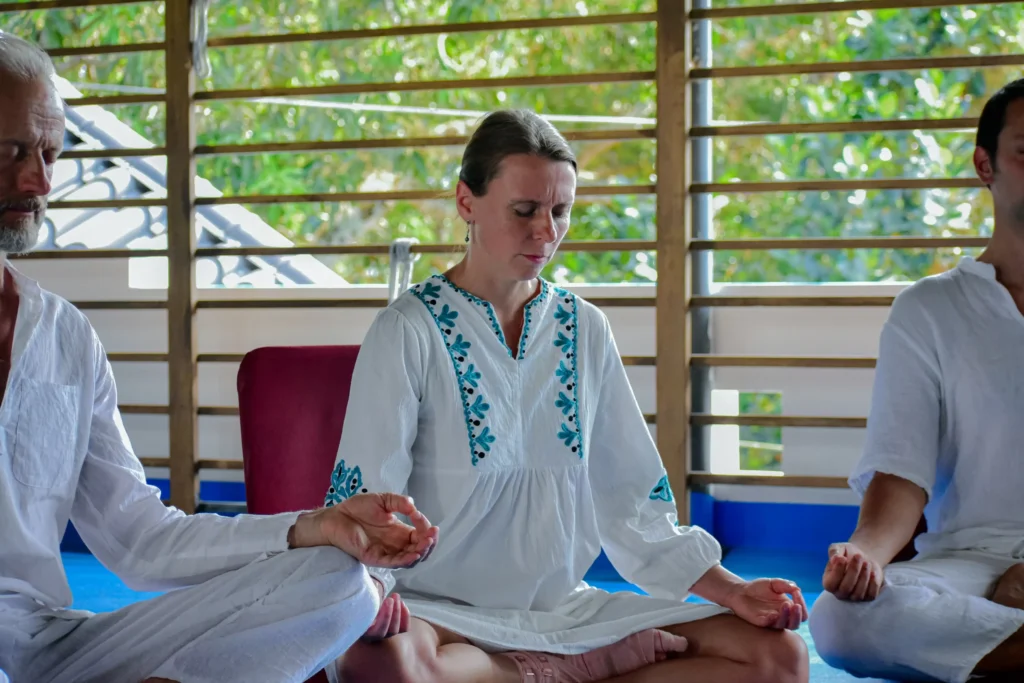
Ask most people what yoga meditation looks like, and you’ll get some version of the same image: sitting cross-legged, eyes closed, trying not to think. That’s not wrong, exactly. It’s just a very narrow slice of what traditional meditation practice actually includes.
Hatha Yoga carries a much wider set of tools than that, each aimed at a slightly different way of steadying the mind.
Where Meditation Sits in the Traditional Path
In the classical framework of the 8 limbs of yoga, meditation doesn’t stand alone. It follows concentration, known as dharana, and deepens into what’s called dhyana, a state of sustained, absorbed attention.
This matters because it explains why meditation was never meant to be the very first thing someone does. The body needs some steadiness through asana, the breath needs some regulation through pranayama, and only then does sitting quietly actually start to work the way it’s meant to.
Trataka — Concentration Through Steady Gazing
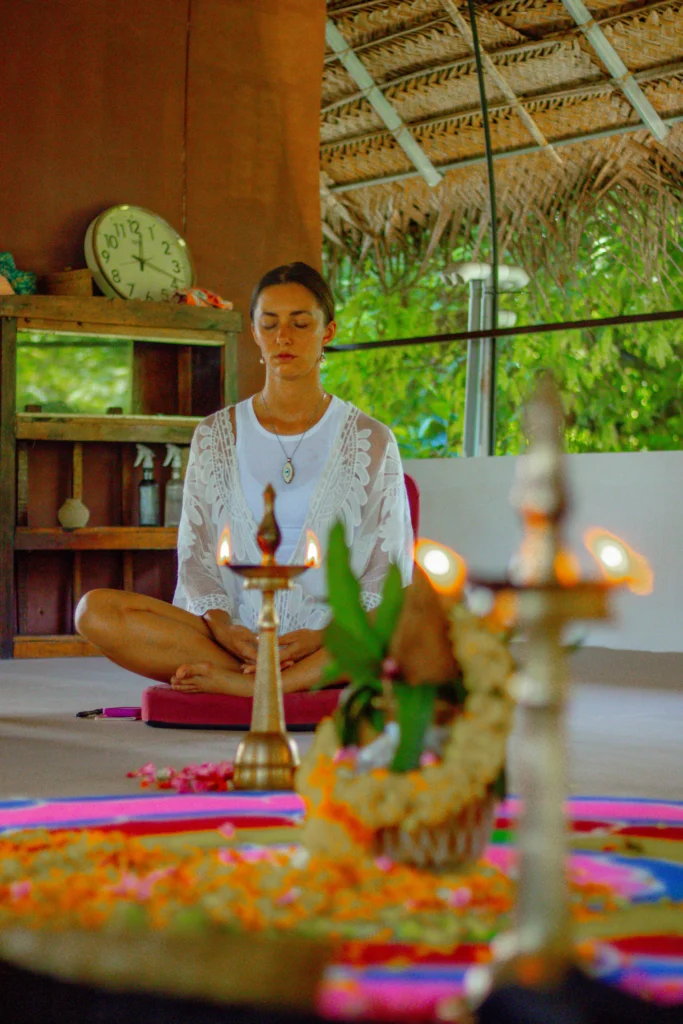
Trataka is a fixed-gaze concentration practice, traditionally done on a candle flame, though other single points of focus can be used. The eyes rest softly on the point without blinking for as long as comfortable, then close, and the after-image is observed internally.
Its function is training the wandering mind to hold one point of focus. This is harder than it sounds; most people notice almost immediately how quickly attention slips. That difficulty is actually the value of the practice. Trataka is traditionally grouped with the shatkarma cleansing techniques as well, since sustained gazing is also considered a purifying practice for the eyes and mind together.
Yoga Nidra — Conscious Relaxation, Not Sleep
Yoga Nidra is often described as “yogic sleep,” which is a bit misleading. It’s not sleep. It’s a state of deep physical relaxation while the mind remains quietly aware, guided through a structured sequence of body awareness and breath.
The distinction matters because falling asleep during Yoga Nidra actually means missing the practice, not succeeding at it. The value is in staying just on the edge of sleep while consciously aware, which is a genuinely different state than either ordinary wakefulness or sleep itself.
Mantra Meditation and Sound-Based Practice
Mantra meditation uses repeated sound, whether silently or aloud, as the object of focus instead of the breath or a visual point. Traditionally called japa, this repetition gives the mind something rhythmic and steady to return to whenever it wanders.
This is one reason chanting is woven into many traditional Hatha classes rather than treated as a separate ritual. The sound itself becomes the anchor, functioning much like a mantra-based meditation practice even during a physical class.
Why These Techniques Aren’t Interchangeable
A common assumption is that all meditation styles are roughly the same thing done slightly differently. In the traditional framework, they’re actually addressing different needs. Trataka builds the capacity to concentrate. Yoga Nidra addresses accumulated physical and nervous tension. Mantra practice gives the mind something rhythmic to hold onto when silence alone feels too difficult to sustain.
A teacher who understands these differences can guide a student toward the technique that actually matches what they need in a given season of practice, rather than defaulting to one style for everyone.
Learning Meditation Within a Structured Practice
At Pranam Yoga Joseph in Varkala, Kerala, meditation is taught as part of the same traditional structure as asana and pranayama, not as an isolated add-on session. Our 200 Hour Yoga Teacher Training includes Trataka, Yoga Nidra, mantra meditation, and guided visualization as part of daily practice, alongside instruction in how to guide these techniques for others.
If you’d like to understand how stillness fits into the broader practice beyond meditation itself, our article on why stillness is an essential part of yoga explores this further.
FAQ
What is Trataka meditation?
Trataka is a concentration practice involving steady, unblinking gazing at a fixed point, traditionally a candle flame, used to train focus and considered a purifying practice for the eyes and mind.
Is Yoga Nidra the same as sleep?
No. Yoga Nidra is a state of conscious relaxation where the body rests deeply while awareness remains present, distinct from ordinary sleep.
What’s the difference between meditation and mindfulness in yoga?
Traditional yoga meditation typically involves a specific technique and object of focus, like a mantra or fixed gaze. Mindfulness more broadly refers to sustained present-moment attention, which meditation techniques are one structured way of developing.
How is traditional yoga meditation different from guided meditation apps?
Traditional techniques are rooted in a specific classical framework, the 8 limbs of yoga, with each technique serving a distinct traditional purpose, rather than being generalised relaxation content.
Conclusion
Meditation in Hatha Yoga was never meant to be one single technique done the same way by everyone. It’s a set of tools, each suited to a different part of a restless mind, and understanding that difference is often the first real step toward a practice that actually settles.