
here is a version of yoga that lives on screens and in magazines which split legs, deep backbends, bodies folded into shapes that look more like sculpture than movement. It’s striking to look at. And for many beginners, it quietly sets the bar for what success in yoga is supposed to look like.
The problem with that picture isn’t that those postures don’t exist. They do, and some practitioners genuinely reach them through years of consistent, patient work. The problem is when that image becomes the measure of progress for everyone, including people who’ve just started, or whose bodies aren’t built for extreme ranges of motion, or who simply want to practise yoga without turning it into a performance.
Yoga flexibility, understood well, has very little to do with how deep a posture looks. It has much more to do with how the body moves, how consistently you practise, and whether what you’re doing is actually sustainable over time. That reframe changes the whole experience of practice and this article explores why.
Why Advanced Yoga Poses Are Not the Only Measure of Progress
Advanced yoga poses attract attention because they are impressive. A deep hip opener held with ease, a balanced arm inversion, a backbend that seems to defy normal spinal range, these are the images that circulate most widely, and they create an unspoken impression that this is what yoga is building toward.
In reality, these postures represent the visible edge of what is possible for certain bodies after extensive preparation. They are the result of yoga progress not a shortcut to it. And the preparation that makes them possible is not just stretching further. It’s years of developing strength, joint awareness, breath control, and a reliable understanding of what the body is actually doing in a posture.
A practitioner who can hold a simple seated posture with honest alignment, steady breath, and genuine attention is doing something more meaningful than someone forcing a dramatic shape while holding their breath and hoping for the best. Both things can look very different from the outside. On the inside, only one of them is actually practising yoga.
Progress in yoga isn’t hidden in difficult poses. It is in the quality of how someone moves, breathes, and pays attention and that quality can develop in any posture, at any level.
Progress Looks Different for Every Practitioner
One reason comparison tends to lead yoga practitioners astray is that bodies genuinely differ in ways that have nothing to do with effort or commitment.
Hip socket depth and angle, spinal curve, limb length, natural tissue elasticity these factors vary considerably from person to person, and they directly affect how a posture looks and feels. Two students practising with equal consistency and sincerity for the same amount of time will not end up in identical positions. That’s not a problem to solve. It’s just anatomy.
Meaningful progress is about what changes over time in your own practice, not how your postures compare to someone else’s. A little more ease in a posture that used to feel restricted. A steadier breath in something challenging. A more honest sense of where your edge actually is, as opposed to where you wish it were. These are the real markers of a practice that’s going somewhere.
Building Yoga Flexibility Through Consistent Practice
The most reliable way to improve flexibility with yoga isn’t to stretch harder, it’s to practise more regularly. The body adapts to what it encounters consistently. Muscles, connective tissue, and the nervous system all adjust gradually over time, but only when the practice meets them where they are rather than forcing them past it.
For a yoga practice for beginners especially, consistency matters far more than intensity. The temptation early on is to push into the full version of a pose before the body has the strength to stabilise that range. Stretching into instability creates strain, not progress and it’s one of the most common reasons early practitioners plateau or get discouraged.
Strength and flexibility develop together in a balanced practice. A muscle that can lengthen fully is also one that can control that length holding the joint stable rather than just collapsing into the end of its range. That combination is what functional flexibility actually means: range of motion you can use, not just achieve briefly while holding your breath.
Why Safe Yoga Practice Begins With Good Alignment
Alignment sometimes gets taught as though it’s about aesthetics – arms at this angle, feet this distance apart, hips squared perfectly forward. But genuine alignment has nothing to do with appearance. It’s about creating the conditions for the body to work efficiently and safely, whatever shape that takes for a particular person in a particular posture.
A safe yoga practice is built on this understanding. When a joint is in good alignment, the surrounding muscles can engage effectively, the breath can move freely, and the body isn’t compensating for instability somewhere else. When alignment breaks down it’s often in pursuit of going further into a posture than the body is ready for the chain of efficient movement breaks down with it, and load ends up in places that weren’t designed to carry it.
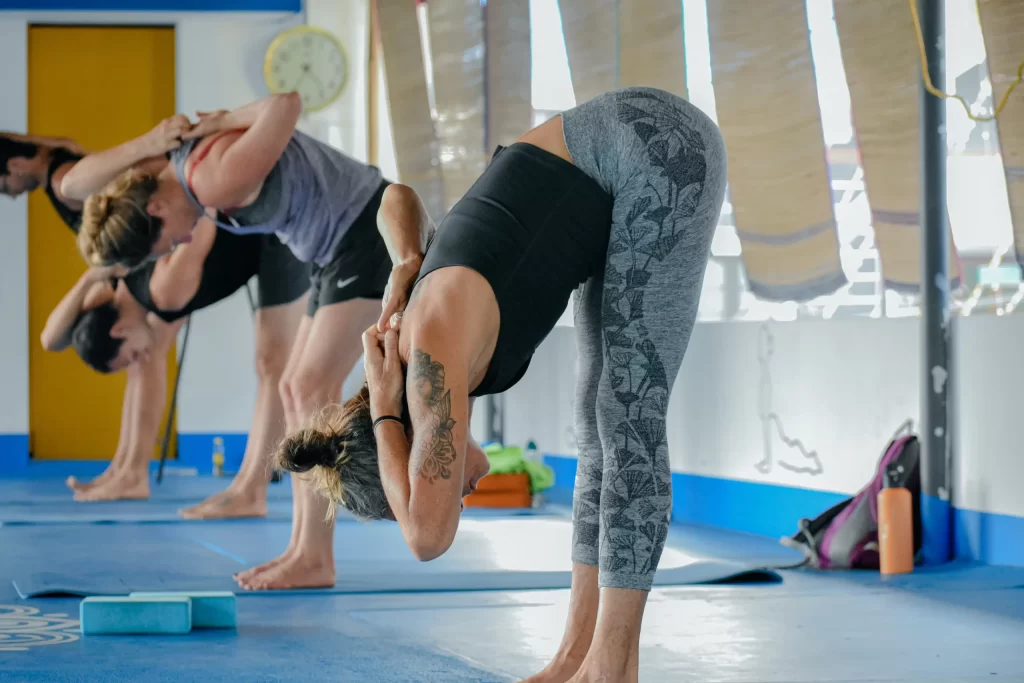
Yoga pose alignment, taught well, is deeply personal. A teacher looking at two students in the same posture isn’t trying to make them look identical. They are looking for whether each body is in a position that allows it to function well – stable at the joints, engaged in the right muscles, breathing without restriction.
Body awareness develops through this kind of attention. Over time, practitioners start to feel the difference between a posture that’s working well for their body and one that isn’t not because they have memorised a rule, but because they have developed an honest internal sense of what healthy movement patterns feel like from the inside.
That sense, once developed, is genuinely useful. It’s what allows someone to practise independently and still make good choices about their own body.
Developing Mobility Alongside Flexibility
Flexibility and mobility are related but they are not the same thing, and understanding the difference matters for how you approach practice.
Flexibility generally refers to how far a muscle or group of tissues can lengthen and the passive range available in a joint when there is no active work required to get there. Yoga for mobility is about something slightly different: how much of that range you can actually use with control. It’s the active, usable version of range of motion and the ability to move into a position and also move out of it with intention, rather than needing to collapse or use momentum to change position.
A body with good mobility moves with more ease and less effort, because the nervous system trusts it. When joints have been trained to move with control throughout their range, the unconscious protective tension that the body uses to guard unfamiliar territory gradually reduces. Movement becomes freer, not because something was stretched, but because something was trained.
Bringing mobility and flexibility together in a balanced yoga practice means not only working to lengthen tissues, but also building the strength and coordination to support that length. Mindful movement moving slowly enough to feel what’s happening and make adjustments as you go is how this develops most efficiently. Rushing through postures gives you neither.
A sustainable yoga practice is one built on this foundation: gradual, consistent, honest about where the body actually is rather than where someone wants it to be. It grows more slowly than a forced approach, but what it builds tends to last.
Flexibility Is a Direction, Not a Destination
Returning to where this began is the image of yoga as a collection of impressive, difficult shapes. there’s something worth saying plainly: that image is a narrow slice of a much larger practice.
Yoga flexibility, genuinely developed, is not the ability to contort the body into extreme positions. It’s the gradual opening of movement capacity through honest, consistent work that respects the body’s actual limits and timeframes. It looks different in every practitioner. It develops at different rates. And it matters most not for what it looks like from the outside, but for what it feels like and makes possible from the inside.
The most sustainable yoga practice is one that values quality of movement over achievement of shapes, that builds body awareness alongside physical capacity, and that treats the body as something to be understood and worked with rather than overcome.
That kind of practice doesn’t have an endpoint. It just keeps getting more interesting – which, for most practitioners, turns out to be far more rewarding than any advanced pose ever was.
Develop Your Practice With Guidance
If you are interested in building your flexibility, mobility, and overall yoga practice with experienced, progressive teaching, explore our programmes at Pranam Yoga Joseph in Varkala, Kerala – where flexibility is approached through mindful, patient practice rather than performance: