
Most of us know what it feels like to be busy. The days fill up before we have had a chance to think about them. Screens, schedules, notifications, deadlines – and somewhere in between all of that, a vague sense that something quieter is missing.
This is exactly the gap that traditional Hatha Yoga was built to address. Not to fix the busyness from the outside, but to change your relationship with it from the inside. The Hatha Yoga benefits that practitioners often speak about are not just physical – they are a reorientation of how you move through life altogether
Modern Life and the Need to Slow Down
Speed has become a kind of default. We have accepted fast as normal – fast food, fast fitness, fast results. Yoga, in many modern interpretations, has followed suit: power flows, sculpt classes, yoga-HIIT hybrids designed to burn calories and build muscle as efficiently as possible.
None of that is inherently wrong. But it does raise the question: if your practice mirrors the pace of the life you are trying to find balance from, what is it actually offering you?
A slow yoga practice is not about being passive or unchallenging. It’s about giving the body and mind enough time to actually register what’s happening. In traditional Hatha Yoga, a posture is not something you pass through – it’s something you arrive at, settle into, and learn from. The difference in experience is significant.
Understanding Traditional Hatha Yoga
The word “Hatha” is often translated as “sun and moon” – Ha meaning sun and Tha meaning moon – pointing to the balance between opposites: effort and ease, strength and flexibility, movement and stillness. This balance is not just poetic. It is the governing principle behind an entire traditional Hatha Yoga practice. Rooted in classical texts like the Hatha Yoga Pradipika, this tradition is several centuries old and was never designed as a fitness system. It was designed as a preparation – a way of working with the physical body so that the mind could become steadier, the breath more refined, and the practitioner more available for deeper states of awareness.
Hatha Yoga philosophy understands the body not as something to be shaped for appearance but as a vehicle for inner experience. Every asana has a specific function – some build heat and stability, others release tension held deep in the connective tissue, others open the breath. Practised in sequence with that understanding, traditional Hatha Yoga becomes something quite different from a fitness class. It becomes a genuine inquiry.
H2: More Than Physical Exercise
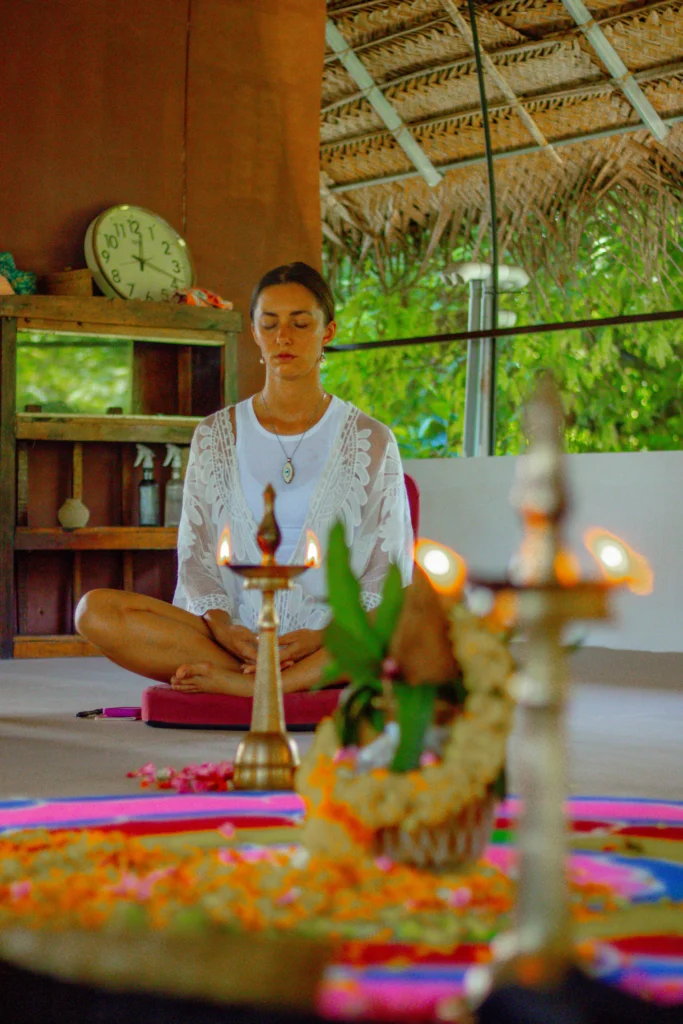
One of the things that surprises people when they encounter is an authentic Hatha Yoga practice for the first time is how little of it is actually about the posture itself. Yoga beyond asanas – the breath, the gaze, the quality of attention brought to each moment – is where the real practice lives.
In a traditional class, you might spend several minutes in a single posture, not because it is easy, but because the time is needed to go beyond the surface of what the body is doing and into what the mind is doing with it.
Are you forcing? Are you judging? Are you rushing toward the next thing even while you are here?
An authentic yoga practice holds a mirror up to habits that most of us carry everywhere. The mat becomes a place to notice them – not criticise them, but notice them – and gradually, that noticing begins to shift how you respond in daily life too. That’s not something a workout promises. It’s something a practice delivers.
Breath, Awareness, and Presence
If there is one element that most clearly distinguishes traditional Hatha Yoga from a modern movement class, it is the breath. Breath awareness in yoga is not a technique that you add on at the end of a class.
In the traditional understanding, the breath is the practice itself. The body moves in relationship to the breath, not the other way around. When the breath becomes forced, shallow, or held, it is a signal that something in the body or mind has been asked to do more than what it’s ready for.
Pranayama in Hatha Yoga – the systematic regulation and refinement of breath that sits at the heart of the tradition. Classical techniques like Nadi Shodhana (alternate nostril breathing), Ujjayi (victorious breath), and Bhramari (humming bee breath) are not supplementary exercises. They are primary tools for working with the nervous system, clearing mental fog, and building the kind of internal steadiness that no amount of physical training alone can produce.
Practising these techniques consistently, with a teacher who understands their purpose, creates a quality of mind-body awareness that begins to carry beyond the practice session and into ordinary life.
Living the Practice Beyond the Mat
Perhaps the most underestimated aspect of traditional Hatha Yoga is that the practice doesn’t end when you roll up your mat. A traditional yogic lifestyle is not a rigid set of rules – it is an orientation toward simplicity and awareness. How you sleep, eat, speak, and respond to difficulty are all understood, in the traditional view, as extensions of the practice itself.
A daily yoga practice, even a short one approached with genuine attention, builds something that occasional intense sessions cannot: continuity of awareness. That accumulation, over time, is where the real shift happens.
Is Traditional Hatha Yoga Suitable for Beginners?
Completely – and in some ways, it is the ideal starting point.
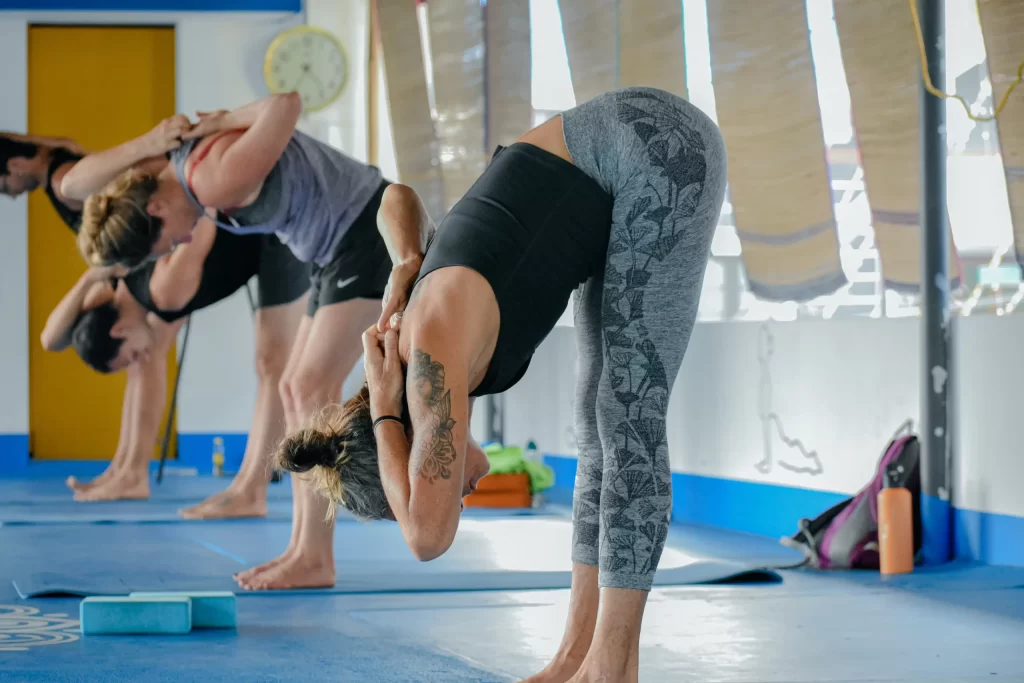
Because traditional Hatha Yoga moves at a pace that allows real understanding to develop, beginners are not pushed past their capacity before they have had a chance to develop awareness of their own bodies. There is no performance pressure, no expectation to keep up with a fast-moving class. Instead, there is time – to feel, to adjust, to ask questions, and to actually absorb what’s being taught.
The Hatha Yoga benefits that build over time – steadier breath, calmer nervous system, better physical awareness, genuine mental clarity – are accessible to anyone willing to show up consistently and with sincerity. No prior experience required. Just an honest intention to learn.
Why It Feels Different
People who come to traditional Hatha Yoga after years of modern fitness yoga often describe the experience the same way: quieter, slower on the outside – but somehow more demanding on the inside.
That is because the practice asks for a quality of attention that rushing never allows. When you stop trying to achieve a shape and start trying to understand a posture, something shifts. When you stop breathing automatically and start breathing consciously, something else shifts. When your daily yoga practice becomes a genuine part of how you live rather than a box you tick, the whole texture of your day begins to change.
That is what traditional Hatha Yoga offers. Not a workout. Not a trend. A practice – one that has been meeting people exactly where they are for centuries, and continues to do so today.
Experience It in Varkala, Kerala
At Pranam Yoga Joseph in Varkala, Kerala, traditional Hatha Yoga is not a style we have adopted – it is the lineage we come from. Founder Joseph Konnoth trained under Guru TA Raman Asan and has carried these teachings forward with care for decades. Every programme we offer – from drop-in classes to our structured 100 Hour Yoga Teacher Training and 200 Hour Yoga Teacher Training – is rooted in the same traditional foundation.
Varkala itself is part of why the practice feels the way it does here. A coastal town on the cliffs of southern Kerala, it carries a natural quiet that city life rarely allows. The environment, the lineage, and the small-group teaching approach come together in a way that is genuinely different from most yoga experiences available today.
If you have been wondering whether there is a deeper layer to yoga than what you have found so far – there is. And we would love to show you what authentic Hatha Yoga practice looks and feels like.
Traditional Hatha Yoga has been at the centre of teaching at Pranam Yoga Joseph since the school’s founding in Varkala, Kerala. If you would like to experience this practice in its original depth with a teacher rooted in lineage, in a setting built for genuine learning – explore what we offer here.