
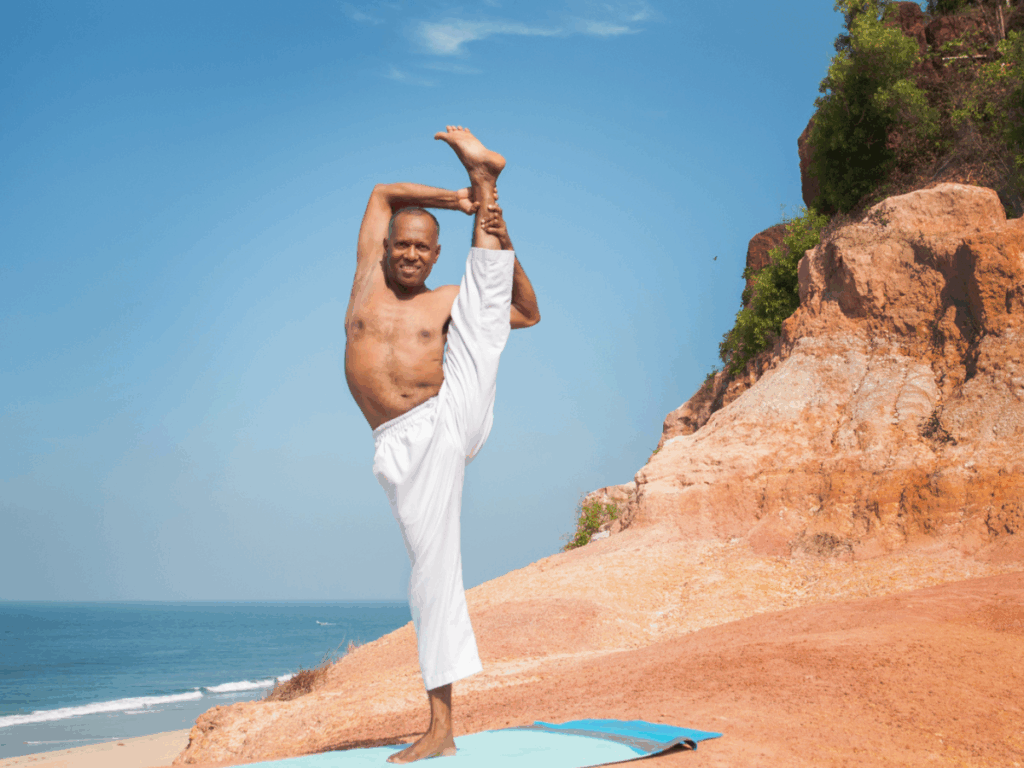
Yoga is practised in more ways today than ever before. Studios offer everything from fast-paced flow classes to restorative sessions, from hot yoga to aerial yoga. Each of these has its own value, and each draws people for different reasons.
Within all of this variety, many practitioners – especially those who have been practising for a while have started to become curious about where yoga originally came from and what the practice looked like before it became so diverse. That curiosity often leads to traditional Hatha Yoga.
This article looks at what traditional Hatha Yoga actually is, what it was built to do, and how its approach to teaching and practice differs from many of the modern styles that are popular today. The aim isn’t to suggest that one is better than another. The aim is simply to give a clear picture of what traditional practice involves, so that you can make an informed choice about the kind of yoga you want to explore.
Understanding the Origins of Traditional Hatha Yoga
The history of Hatha Yoga stretches back several centuries in India. It developed as a structured, methodical approach to preparing the body and mind – not primarily for fitness or flexibility, but as a foundation for deeper inner work.
The earliest systematic descriptions of Hatha Yoga appear in texts like the Hatha Yoga Pradipika and the Gheranda Samhita, written between the 15th and 17th centuries. These texts laid out a clear path: work with the body through postures, work with the breath through pranayama, steady the mind through concentration and meditation. Each stage prepared the practitioner for the next.
What’s important to understand is that this wasn’t a casual activity. It was a complete system taught by experienced teachers to committed students, passed down through direct instruction and personal practices. The body was never the endpoint. It was the starting point.
The Purpose Behind Traditional Hatha Yoga Practice
The purpose of Hatha Yoga, as it was originally understood, was never simply physical. Strength and flexibility were considered useful – but they were useful because they made the body a more stable and comfortable place to sit, breathe, and turn inward.
Traditional yoga teachings place awareness, balance, and discipline at the centre of practice. A student learning in the traditional way is not working toward a specific pose as a goal. They are working toward steadiness in the body, in the breath, and eventually in the mind.
This is why consistency matters more than intensity in traditional practice. A student who practises with genuine attention for thirty minutes every day develops differently than someone who pushes hard once a week. The traditional approach values regularity and honesty about where you are over performance and pushing past limits.
Self-observation is also a core part of traditional Hatha Yoga practice – not in a complicated philosophical sense, but in a simple, practical one. You learn to notice how your body responds, how your breath changes, and how your level of attention shifts from one day to the next. Over time, this builds a kind of inner sensitivity that changes how you relate to your practice and to your life outside it.
Looking Beyond the Difference Between Hatha Yoga and Modern Yoga
When people talk about the traditional way of Hatha Yoga vs modern yoga, the conversation can sometimes feel like a debate, as if one side has to win. That framing isn’t a particularly useful.
The real difference between Hatha Yoga and modern yoga is one of the emphasis and the intention rather than right and wrong. Modern yoga classes, especially those that grew out of the 20th century fitness movement, tend to prioritise physical development, accessibility, and class-to-class variety. Many modern teachers are genuinely skilled, and many students genuinely benefit from what those classes offer.
Traditional Hatha Yoga, by contrast, tends to move more slowly, place greater emphasis on breath awareness, and encourage precision in posture rather than range of movement. Progress is understood as something that happens over months and years, not weeks. Classes often cover the same ground repeatedly and deliberately, because repetition with attention is how understanding actually builds.
Neither approach is without value. But they are reaching for different things, and knowing that helps you choose more clearly.
Why the Intention Behind Practice Matters More Than the Style
Whatever style of yoga you practise, what drives the quality of that practice is not the name on the door. It is the intention you bring, the guidance you receive, and whether you are consistent enough for something real to develop.
A traditional class taught without genuine care is less useful than a modern class taught with honesty and skill. The style creates the conditions – the practitioner and the teacher determine what actually happens within them. This is worth keeping in mind as you explore what kind of practice suits you best.
How Traditional Yoga Methods Shape Long-Term Practice
One of the defining features of traditional yoga methods is that they are gradual by design. There is no shortcut built into the system which is not because of the tradition is rigid, but because the things it’s trying to develop simply take time.
A student learning traditional Hatha Yoga is typically guided through a steady progression. Foundational postures are taught with care before more complex ones are introduced. Breath awareness comes before pranayama techniques are explored in depth. Concentration practices are introduced once the body and breath have some stability.
This is not a slow for the sake of being slow. It’s careful in the way that any genuine skill-building is careful. You don’t learn to read by starting with complex texts. You build from simple to complex, returning to the basics regularly because they never stop being relevant.
In practice, this means that students who learn through traditional methods often find that their understanding of quite simple postures continues to deepen even after years of practice. The poses don’t get old, the quality of attention you bring to them keeps developing
Learning Through a Traditional Yoga Lineage
The idea of a traditional yoga lineage can sound formal or exclusive, but at its core it’s quite simple. It refers to a chain of knowledge passed from teacher to student, where each person in that chain learned through direct practice and personal guidance rather than through books or online content alone.
Lineage matters because yoga, especially in its traditional form it involves the things that are difficult to fully understand from a distance. The nuances of how to use the breath in a posture, how to adjust your position based on how your body is responding on a given day, how to work with the nervous system through pranayama. These are things that a teacher who has practised and taught for many years can convey in ways that a video or manual simply cannot.
At Pranam Yoga Joseph in Varkala, Kerala, the teaching lineage runs through Guru TA Raman Asan, whose influence shaped the way founder Joseph Konnoth learned and continues to teach. That direct transmission is at the centre of everything taught here – not as a point of prestige, but as a practical reason why the teaching is grounded and clear.
Why Traditional Hatha Yoga Continues to Matter Today
Classical Hatha Yoga has remained relevant not because it’s old, but because what it offers hasn’t been replaced by anything newer.
In a world where most things are designed for speed and immediate feedback, a practice that asks you to slow down, pay attention, and return consistently to the same foundation is genuinely countercultural. Many people who come to traditional Hatha Yoga, especially those who have already explored more modern styles, describe a sense of arriving somewhere they didn’t know that they were looking for.
The steady, mindful quality of traditional practice, its emphasis on breath, its respect for the body’s actual limits rather than an idealised version of what it should look like – these remain as useful today as they were when the tradition was first established.
Traditional Hatha Yoga doesn’t promise fast results. It promises something more durable: a practice that grows with you, that continues to offer something new even as the postures stay familiar, and that gradually changes not just how you move but how you pay attention to your own life.
If you are drawn to learning yoga in this way – structured, careful, rooted in tradition – that’s exactly what we offer at Pranam Yoga Joseph in Varkala, Kerala.
If you are interested in learning how traditional Hatha Yoga is taught through a structured, experience-based approach, explore our 100 Hour Yoga Teacher Training and 200-Hour Yoga Teacher Training programmes at Pranam Yoga Joseph.
For a closer look at what yoga teacher training involves beyond physical postures, you may also find this useful: What Makes Traditional Hatha Yoga Feel Different in a Fast-Paced World
Looking for Yoga Teacher Training in Varkala, Kerala?
If India is where you want to take your training, you can join us at Pranam Yoga Joseph in Varkala, Kerala. Our teacher training is centred around traditional Hatha Yoga and Hatha Vinyasa, with small groups, hands-on learning, and a practical approach that brings modern anatomy and biomechanics into the practice.
Explore our Yoga Teacher Training in Varkala →
Considering Yoga Teacher Training in Bali or Thailand?
If you’re looking beyond India, Bali and Thailand offer a very different setting for your training. All Yoga Training offers Yoga Alliance registered yoga teacher training programs in Bali and Thailand, combining traditional yoga foundations with modern teaching methodologies.