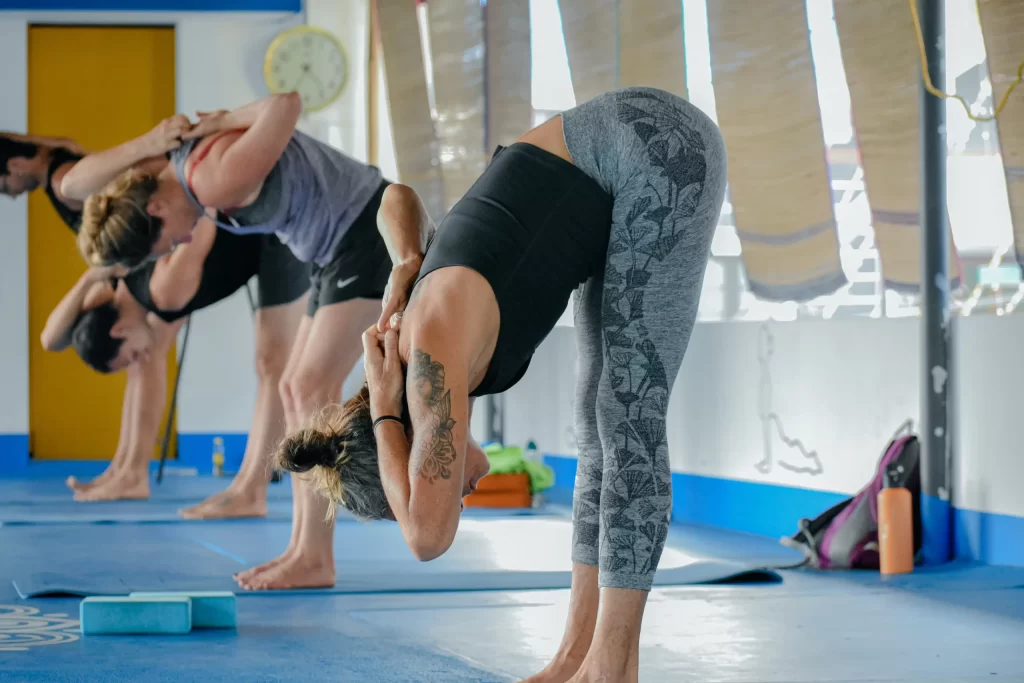


When most people hear the word “anatomy,” they picture textbooks, diagrams, and medical terminology. It sounds like something reserved for doctors or physiotherapists, not something a yoga student needs to think about.
But yoga anatomy, in the way it is actually taught in a good training environment, is far simpler than that. It’s really just learning to pay attention to your own body – understanding how your joints move, where your muscles are working, and what your body is actually doing during a posture, rather than what it looks like from the outside.
Once you start looking at yoga through that lens, something shifts. Practice becomes more informed. You start making small adjustments that feel right rather than just copying a shape. You understand why a pose feels different on Tuesday than it did on Monday. And over time, that understanding makes your practice both safer and more sustainable – not because you have studied hard, but because you have started listening more carefully.
The Basics of Anatomy in Yoga
Basic anatomy for yoga doesn’t mean memorising the names of every muscle. It means developing a working understanding of how the body is put together and how that affects the way you move.
In any yoga posture, three things are always at play: the bones that create the structure, the joints that allow movement, and the muscles that control and support that movement. These three elements work together constantly, and the quality of that relationship determines how a posture feels and functions.
Bones aren’t flexible, they are fixed in shape. This matters because the shape of your bones, particularly around the hip socket and shoulder joint, directly affects how far you can move in certain directions. Two people with different bone structures will experience the same pose quite differently, and neither experience is wrong. It’s simply anatomy at work.
Joints sit between the bones and allow movement to happen. Each joint has a natural range, some joints are designed for broad movement, like the hip, while others are built more for stability, like the knee. Understanding this in yoga means learning to respect what each joint is designed to do rather than asking it to do something it wasn’t built for.
Muscles are what make all of this move. In yoga, you are constantly working with the balance between muscles that are lengthening and muscles that are actively holding. Learning to feel that balance, rather than just stretching as far as possible is one of the most practical things anatomy in yoga teaches you.
How Yoga Biomechanics Helps You Move More Efficiently
Biomechanics is simply the study of how the body moves, how forces work through the joints and muscles to create action. In a yoga context, it’s not complicated. It’s really just asking: what is actually happening in the body when this posture is performed?
Understanding yoga biomechanics helps you move more efficiently because it takes the guesswork out of practice. Instead of trying harder when something doesn’t work, you start asking why it doesn’t work. Is the joint not designed for that range? Is the muscle too tight, or not strong enough to stabilise the joint? Is the breath changing how the ribcage moves?
These aren’t questions that need a degree to answer. They just need a little awareness and a teacher who can help you develop it.
Everybody Body Moves Differently
One of the most freeing things anatomy teaches yoga practitioners is that variation in a pose is not a failure. It’s biology.
Two students can have the same level of experience, the same amount of practice behind them, and still look completely different in the same posture because their joint structure, natural flexibility, and muscle patterns are different. One person’s hip socket may face forward. Another’s may angle slightly to the side. That single difference changes what a hip-opening posture feels like and how far it can safely go.
Biomechanics in yoga helps you understand these differences without judgement. The goal isn’t to match someone else’s shape. The goal is to find the most stable, comfortable, and useful version of a posture for your particular body on that particular day.
Why Yoga Alignment Is About Awareness, Not Perfection
Alignment in yoga is one of the most misunderstood ideas in modern practice. It’s often taught as a fixed standard, a specific position that every student should reach, regardless of their body.
But genuine yoga alignment isn’t about perfection. It’s about function. A well-aligned posture is one where the joints are stable, the breath is moving freely, the muscles are working in balance, and the body feels supported rather than strained. Whether that looks identical to the person next to you is entirely beside the point.
Spinal alignment is a good example. The spine has natural curves inward at the lower back and neck, outward at the upper back. Healthy posture in yoga works with these curves rather than trying to flatten or exaggerate them. When those natural curves are respected, the spine can bear load efficiently and the surrounding muscles don’t have to overwork to compensate.
Joint stability is another key idea. A joint that is mobile but not stable is a joint at risk. Good alignment keeps joints in positions where they are mechanically supported where the muscles and connective tissue around them can do their job properly. This is why posture awareness in yoga isn’t just about how you look. It’s about how the body is actually functioning underneath the surface.
Body alignment in yoga, understood this way, becomes something personal rather than prescriptive. It’s a conversation between you and your own body, not a standard imposed from outside.
Building a Safe Yoga Practice Through Anatomical Awareness
A safe yoga practice isn’t about avoiding challenge. It’s about moving with enough awareness that you can feel the difference between productive discomfort and unnecessary strain.
Functional anatomy in yoga gives you the tools to make that distinction. When you understand basic movement mechanics, you start noticing things. You feel when a joint is being asked to move in a direction it was not designed for. You notice when you are holding your breath to push through something rather than breathing through it. You recognise when fatigue is affecting your posture in ways that create more tension than benefit.
Mobility and stability are two qualities that need to work together. Mobility without stability creates unstable joints that can move widely but can’t control that movement. Stability without mobility creates rigidity, a body that is strong but unable to move freely. Functional anatomy helps you find the balance between the two, which is where safe and efficient movement actually lives.
Muscle engagement in yoga is another practical concept. Many students either grip too hard tensing muscles that don’t need to be working or don’t engage enough, leaving joints unsupported. Learning to feel the appropriate level of engagement for each posture is something that develops gradually with practice and body awareness. It can’t be forced, but it can be educated.
None of this requires you to think like a doctor during practice. It just requires you to pay attention in a slightly more informed way.
At Pranam Yoga Joseph in Varkala, Kerala, anatomy is taught as part of both our 100 Hour Yoga Teacher Training and 200 Hour Yoga Teacher Training programmes – not as an isolated academic subject, but woven into the physical practice itself, so that the learning stays grounded and practica
Yoga Anatomy Makes Practice Smarter, Not More Complicated
Coming back to where this began – yoga anatomy isn’t a medical subject dressed up in yoga clothes. It is a practical way of understanding the body you already live in.
When you know a little about how your joints work, you stop fighting your body in postures and start working with it. When you understand basic movement mechanics, you stop measuring your practice against someone else’s body and start developing your own. When you can feel the difference between a posture that is working well and one that is creating unnecessary strain, you start making better choices on the mat and those choices add up over time.
The result is not a more technical practice. It’s a more honest one. More sustainable, more personal, and more genuinely yours.
Ready to Learn More?
If you would like to learn how yoga anatomy, movement awareness, and alignment are taught as part of a structured, hands-on training experience, explore our programmes at Pranam Yoga Joseph in Varkala, Kerala:
H4: Related Reading